iGEMers at the Policy Table: Shaping the Governance of Emerging Biotechnologies with the OECD
How do we innovate in biotechnology responsibly, without slowing progress and increasing risk?
It’s a question that sits at the heart of nearly every debate in synthetic biology today. And it was the animating premise of the OECD-UK Multistakeholder Workshop on Responsible Innovation and Anticipatory Governance of Emerging Biotechnologies, held in Paris on December 9, 2025.
Experts from industry, academia, civil society, policy and government gathered to do something that is deceptively difficult: talk openly about the future of biotechnology before its consequences fully arrive and attempt to translate those conversations into international policy recommendations.
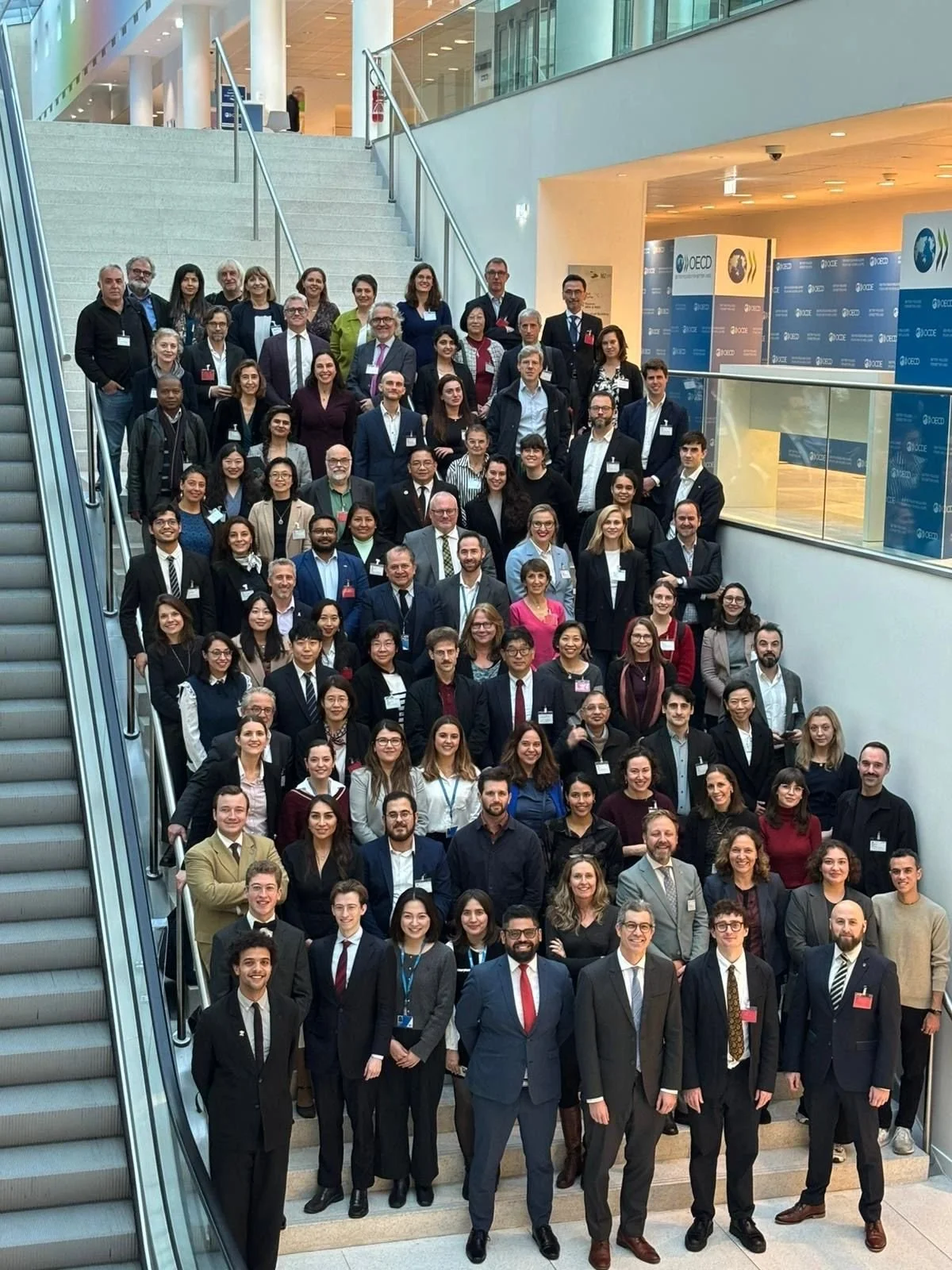
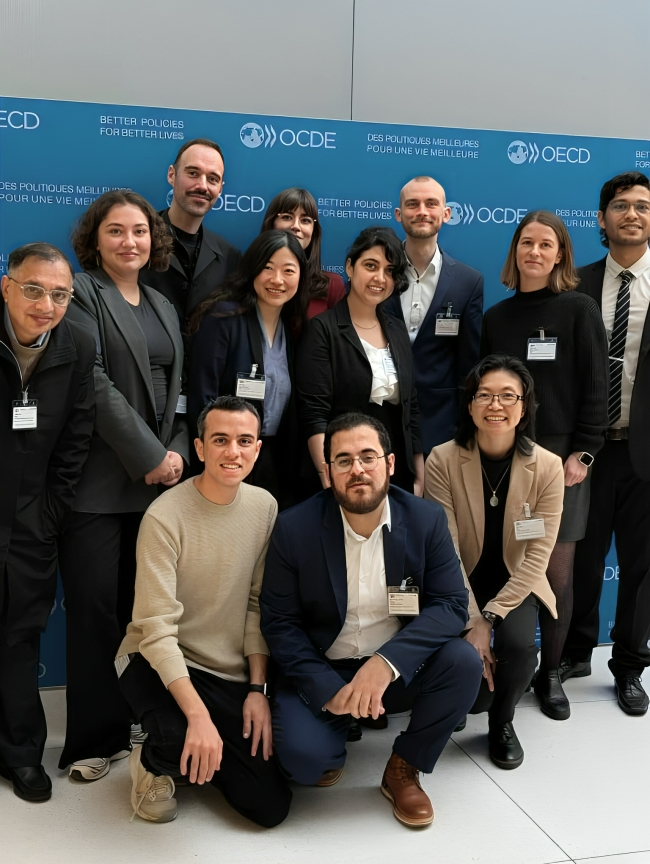
Group photo of the participants at the OECD Multistakeholder Consultation on Responsible Innovation and Anticipatory Governance of Emerging Biotechnologies.
iGEM was invited to participate because of its long-standing role in shaping the foundations of synthetic biology globally. For over two decades, the iGEM Competition has served as a proving ground, not only for new technologies, but for new norms around responsibility, ethics and public engagement. This invitation recognized iGEM not just as a competition, but as a community that has helped define how emerging biotechnologies are learned, practiced and governed.
As part of the OECD consultation, iGEM brought together a delegation of iGEMers, many of whom are now working across academia, research, policy, startups and NGOs, to share perspectives shaped by hands-on experience with synthetic biology.
Participants including Zoran Marinkovic, Youssef Abdelmaksoud, Clemens Boehm, Marguerite Benony, Mariami Kharebava, Patrick Schimpl, Marina Maletic, Aya Gomaa, Angelo Cardoso Batista and Nadine Bongaerts, alongside iGEM HQ representatives Yorgo El Moubayed and Dorothy Zhang, Executive Vice President of iGEM Foundation, contributed across working sessions that reviewed and refined draft policy recommendations.
For many of them, this was their first opportunity to see how global governance is made, not in theory, but in practice.
Several participants reflected on how unusual the setting itself was. Scientists sat next to policymakers. NGO representatives debated industry leaders. Early-career researchers spoke alongside senior regulators. And this diversity was not incidental as Nadine Bongaerts noted, meaningful governance of emerging biotechnologies will depend on cross-sector and cross-country collaboration, not only to harmonize regulation, but to build a shared language across disciplines that often talk past one another.
Another recurring theme was anticipatory governance: the idea that regulation must be flexible enough to evolve alongside rapidly advancing technologies, without defaulting to either paralysis or blind acceleration. Participants emphasized that this kind of governance requires experimentation, humility, and a willingness to revise assumptions as new risks and opportunities emerge.
For Clemens Boehm, iGEM’s emphasis on applied responsibility shaped how he approached these discussions.
“Through iGEM, we see firsthand how rapidly the possibilities in biotechnology are expanding. That perspective helped keep the conversation less abstract and more grounded. As early-career researchers, we also bring hands-on laboratory experience, which makes potential risks and constraints concrete, but also clarifies opportunities for public benefit. These questions often shape project directions in iGEM more explicitly than in fundamental research.”
Beyond the policy substance, many iGEMers reflected on the deeper value of the experience. Patrick Schimpl described the consultation as a reminder that biotechnology’s trajectory is shaped as much by governance as by technological breakthroughs.
“Spaces like iGEM function as distributed policy laboratories for global discourse. Beyond engineering bacteria, future ethical norms and safety frameworks are prototyped, providing the bioeconomy with a vital testbed for the responsible. By bridging the bench and the boardroom, iGEMers help governance evolve alongside the technology itself: iGEM allows junior scientists to become co-creators of the regulatory landscape they will one day inhabit.”
Others highlighted how iGEM’s long-standing focus on human practices informed their contributions. Marina Maletic reflected on how early exposure to societal considerations reshaped her understanding of responsibility in science.
“iGEM was my first real introduction to the idea that biotechnology cannot be developed in isolation from society. It taught me to think beyond technical feasibility and consider responsibility, biosafety, and downstream impacts. That mindset directly shaped how I engaged in these discussions.”
She also emphasized why early-career voices matter in governance spaces:
“Students and early-career scientists often bring openness, creativity, and a future-oriented perspective. We’re motivated by the world we’re stepping into, which makes us more willing to question existing frameworks rather than accept them as fixed.”
Across these reflections, one point came up again and again: responsible innovation isn’t about choosing between strict control and complete freedom. It’s about managing the tension between the two. Regulation has to be strong enough to protect people and ecosystems, but flexible enough to keep real scientific work moving.
Several participants also pointed out that the consultation itself was only a starting point. The harder task now is turning shared principles into concrete practices, and ensuring that governance evolves at the same pace as the technologies it’s meant to guide.
By bringing early-career scientists into these conversations, the OECD consultation highlighted something iGEM has been demonstrating for years: biotechnology’s future won’t be shaped by technical breakthroughs alone. It will depend on who is willing to take responsibility for how new science is introduced into the world.