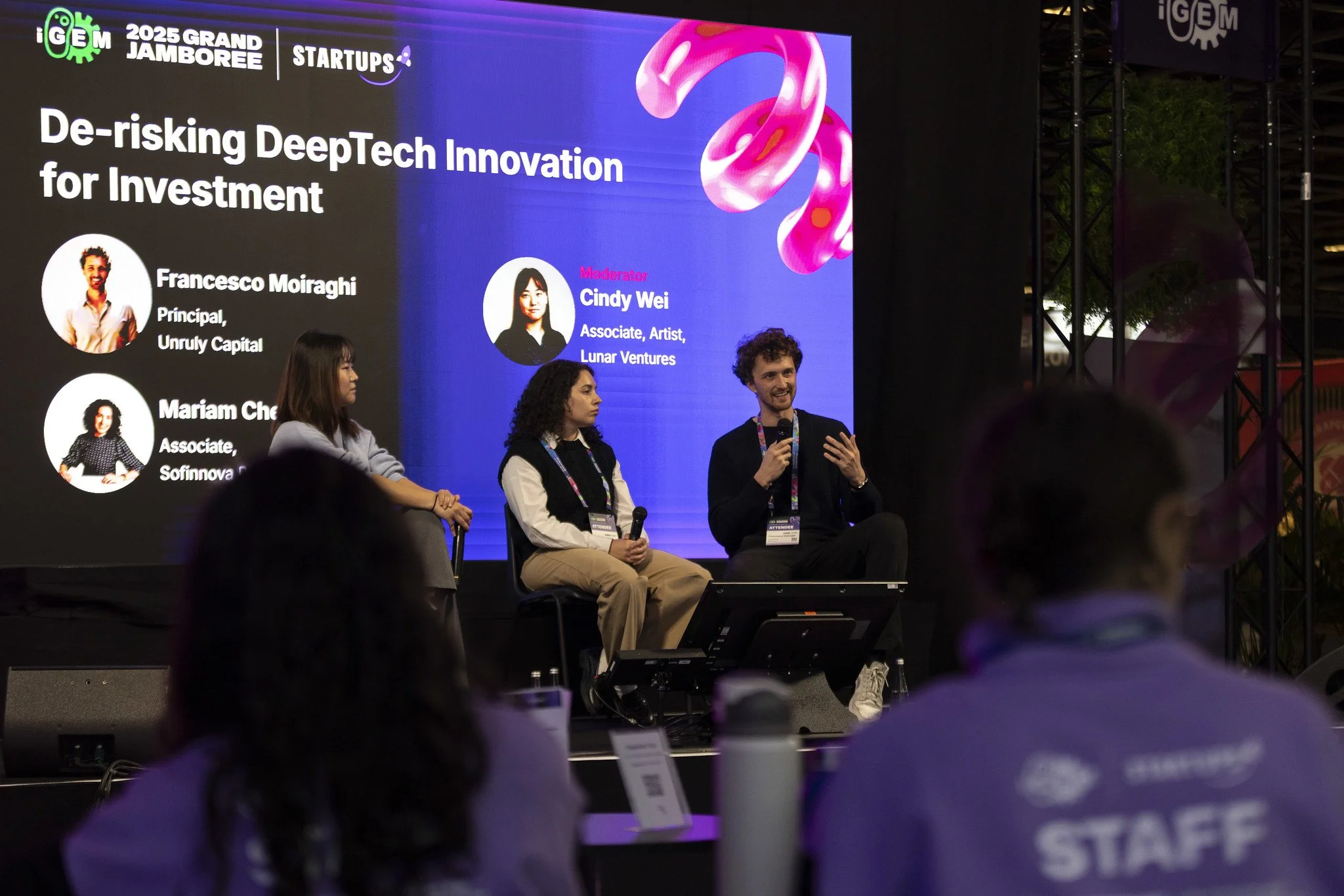
Pitching to a Scientist: A Conversation with Cindy Wei, Associate at Lunar Ventures
Cindy Wei is an Associate at Lunar Ventures, a Europe-based pre-seed and seed deep tech fund built on the thesis that technical founders across Europe need technical venture capitalists to partner with them from day zero, before traction, revenue, or market validation. Most recently, Lunar Ventures launched a €50 million Fund II, investing at the intersection of AI and data infrastructure, space, robotics, science + machine learning, and tech bio. Alongside her investment work, Cindy recently completed her PhD study in Bioinformatics at the Charité and Max Delbrück Center in Berlin, where she sits at a rare intersection: actively doing science while funding it.
In this interview during the iGEM Grand Jamboree 2025, Cindy shares what she looks for in early-stage synbio founders, how her scientific background shapes her investment decisions, and what aspiring bioinnovators should know before walking into an investor's meeting.
How does your scientific background influence your investment decisions?
Cindy's scientific journey was deliberately wide-ranging. She moved between cancer molecular and cellular biology, glucose monitoring algorithm, pathology, and bioinformatics (multi-omics), less out of indecision and more out of a desire to understand how different fields think and operate.
"I jumped around different fields to broaden my understanding and knowledge. But I do think that usually in academia you are working at the frontier, the first line of science and technology. That already helps a lot on how you view things. If this idea is new to you, it's probably also pretty new to the majority in VC."
That frontier instinct, the ability to quickly sense whether an idea is genuinely novel or retreading familiar ground is one of the most valuable things a scientific background brings to investment work.
How important is prior entrepreneurial experience versus academic strength for founders?
For early-stage founders, Cindy's view is clear: deep domain expertise could provide a strong edge against a polished entrepreneurial track record.
"For our fund, we also take fresh PhD graduates because if you have developed your idea from your research, from your PhD studies, then you have already been working on this topic for three to five years at the frontier. That's a very strong incentive to build a startup."
At pre-seed funding, what matters most is usually whether the founder is the best possible person to be working on this specific problem.
What are the biggest green flags and red flags in early-stage synbio startups?
Rather than hard red flags, Cindy thinks more in terms of what BioInnovators still need to work on and the most common gap she sees is insufficient customer discovery.
"The first thing is really trying to talk to your potential customer. In biotech, you probably also need some partnership, whether a co-dev pharma partner or a CRO who actually owns a lab and runs the experiments. Try to figure out who your customer will be and what kind of process you need to scale up your idea within customers’ compliance. For me that is ultra important in biotech."
For green flags, what signals a strong founder to Cindy is a combination of team cohesion, technical credibility, and genuine dedication, including the willingness to commit fully when the time is right.
"The level of dedication needed is doing this full time. Sometimes I talk to people before they even incorporate and that's fine. We keep in touch for a year or two, and when they actually need to fundraise, that relationship is already there. If you say you are devoted to your synbio idea and I see you really working on it over the last years. That's already good enough (for us to look at the idea)."
The Relationship With Investors Starts Earlier Than You Think
One of Cindy's most practical insights is about timing, not of the fundraise itself, but of the relationship that precedes it.
"It can be informal. We could just know each other as someone that I met at iGEM, and maybe a few years later you are building something. Of course, I’m happy for people to reach out anytime."
The message for iGEMers is direct: the conversations you start now; at events, at the iGEM Grand Jamboree, in passing can become the investor relationships that matter later.
For Scientists Who Want to Fund Innovation, Not Found It
For those more drawn to evaluating science than building it into a company, a career in venture capital could be a natural fit. Cindy's first point is that the venture capital (VC) industry is broader than it might appear with different stages, areas, and fund personalities to explore.
Her practical advice for getting started centers on building VC and financial literacy deliberately. She recommends two resources below and also encourages scientists to join hackathons or business games where one can build a real world business case from zero and think through company operations:
Venture Deals by Brad Feld and Jason Mendelson — a foundational book that walks through how VC actually works, from term sheets to cap tables.
The Venture Deals Online Course by Techstar and Kauffman Fellows that works through the real math of fundraising and investing — how you calculate a round, how much equity it represents, and how a cap table evolves after multiple rounds.
"For technical and scientific people coming into VC, don't be too worried about the finance side. If you can crack math, physics, or biology in your academic career, you will be just fine learning financial modelling. A lot of it is learned on the job."
Want more conversations with investors, innovators, and industry experts building the bioeconomy? Subscribe to our mailing list: iGEM Innovation Mail Subscription | *Stay connected with us!*