Building Biology at Scale in Asia-Pacific
Biomanufacturing uses biological systems, such as microbes and cultured cells, to produce useful materials at scale. Its applications range from medicines and industrial enzymes to food ingredients and bio-based materials. Turning these processes into commercially viable production requires more than scientific innovation: companies also need manufacturing infrastructure, investment, regulatory pathways and reliable supply chains.
Across Asia-Pacific (APAC), these requirements bring together markets with different strengths. What is driving the region’s biomanufacturing activity: policy incentives, local demand, established manufacturing capabilities, or a combination of these forces?
This question emerged from our analysis of iGEM’s Venture Creation Lab (VCL), a programme that helps early-stage synthetic biology teams explore and validate their business ideas. Teams are grouped into thematic categories known as “villages”. Biomanufacturing was the largest village among APAC teams in both 2025 and 2026, increasing its share of the regional cohort from 22.5% to 25%.
The trend also extends beyond teams classified within that village. Our analysis of project themes and technologies found that the overlap between the Foundational Advances village, which focuses on developing new biological tools, methods and platforms, and the Biomanufacturing subsector increased by 4.3 percentage points, one of the largest year-on-year changes. This suggests growing interest in the tools and platforms that enable biological production, alongside individual end products.
For this analysis, we examine two overlapping areas: established industrial, or white, biotechnology, encompassing large-scale fermentation, enzymes, bio-based products and scale-up technologies; and emerging food applications, including alternative proteins and cellular agriculture. These areas share underlying technologies and infrastructure but face different regulatory pathways, investment needs and market pressures.
This year’s VCL teams illustrate the breadth of production innovation. APAC Grand Prize winner Oros develops an industrial fermentation platform, while runner-up iGEM Okinawa focuses on industrial enzyme engineering. Judges’ Choice winner Cell Forge develops a ciliate-based precision-fermentation platform for recombinant proteins.
To dig deeper, we spoke to policy experts, investors, founders and specialists from contract research organisations (CROs) and contract development and manufacturing organisations (CDMOs). Through these four perspectives, we explore how APAC’s advantage is becoming systemic rather than purely cost-based, and how connecting complementary strengths across markets can help ventures move from laboratory research to commercial production.
APAC Is Not One Ecosystem
There is no single best place to do biomanufacturing in APAC. The right market depends on what you are developing, manufacturing and selling.
We mapped seven markets against their primary advantages and constraints and three patterns stand out [1] (Table 1), drawing on BioPharma APAC’s editorial assessment and conversations with two experts. Additionally, we consulted Dr Dalal AlGhawas, founder of SWAPAC and former Director at Big Idea Ventures, who consults on commercialization and market entry across APAC and the Arabian Gulf; and Dr Mun Ching Lee, Director of Business Development and Marketing at MabPlex USA, a leading oncology CDMO, with prior experience at CL Biologics and Genscript.
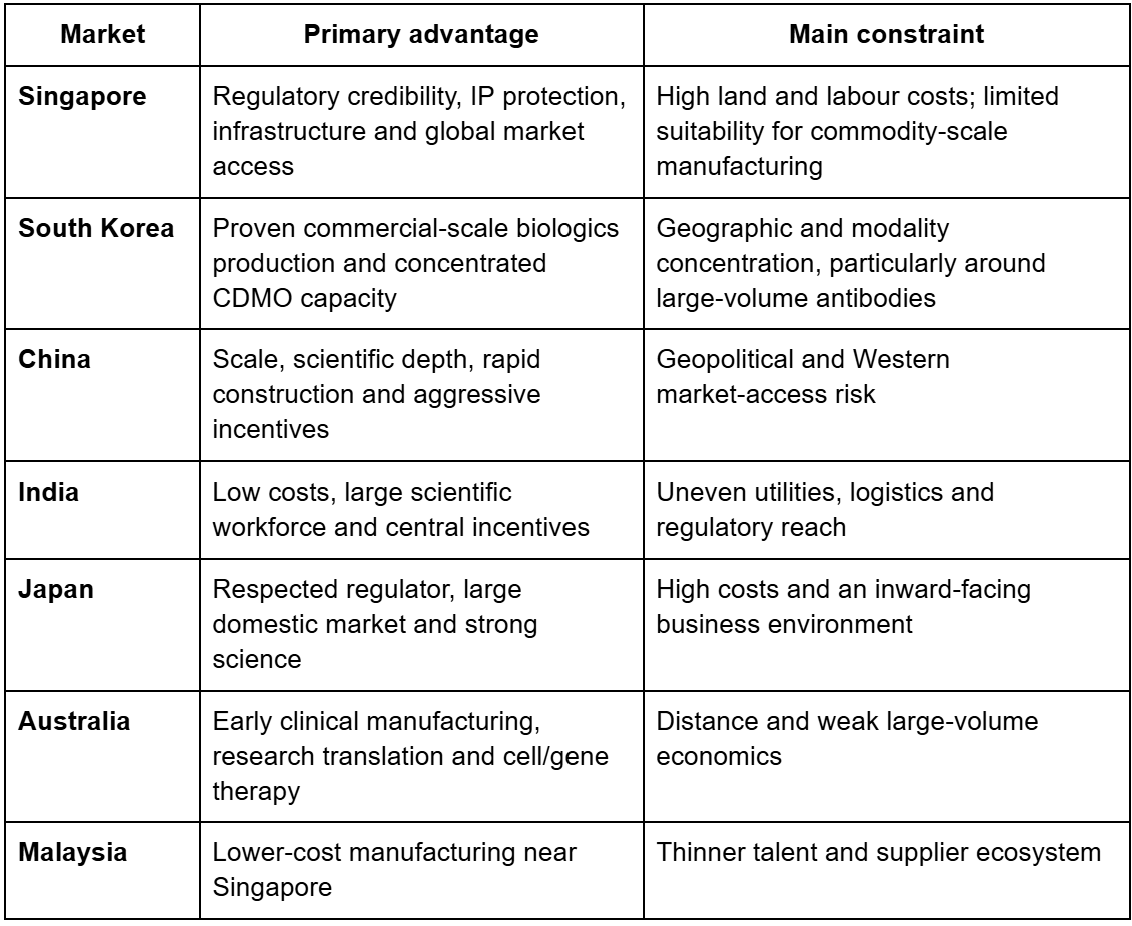
Table 1. The principal advantages and constraints shaping seven APAC biomanufacturing markets. Adapted from BioPharma APAC’s editorial assessment and our expert-led conversations.
Singapore competes on coordination, not cost.
BioPharma APAC ranks it first for regulatory credibility, talent, infrastructure and market access. Its edge is joining up research, IP, regulation and commercial access in one trusted system. Food security shaped that system, since the country imports over 90% of its food. Dr AlGhawas stresses that in Singapore biomanufacturing is a government mandate, not an emergent sector. The country was already a hub for biopharmaceuticals and vaccine development, and alternative protein is now riding infrastructure that was built for something else. RIE2030 reinforces that intent: S$37 billion, a 32% increase on RIE2025, with biomedtech and biomanufacturing named as one of four priority domains [1, 2].
Scale sits elsewhere, and is being repurposed.
South Korea has the region's most concentrated large-scale cluster, led by Samsung Biologics, Celltrion and Lotte Biologics, but mainly in biologics. Dr AlGhawas describes Korea as market-driven rather than mandate-driven: high-brand-equity biopharmaceuticals, cosmetics and food supplements pull demand along, and the CDMO base supplies the fermentation and downstream capability the sector needs. In cellular agriculture, she says, ‘the science is ahead of the approvals table.’ The Gyeongbuk regulation-free special zone (KRW 19.9 billion, ten companies, running to 2028) allows work with biopsy and same-day tissue material that ordinary rules would block, and in June 2026 the Ministry of Food and Drug Safety moved to create a formal ‘cell-cultured processed foods’ category. China pairs huge contract-manufacturing capacity with aggressive provincial incentives. Dr Lee points to free-trade zones and subsidised land and facilities, with Yantai, a coastal city in Shandong province, as one example where biotech-specific incentives have drawn significant investment. From February 2026, the province of Heilongjiang offered reimbursements covering up to 30% of investment in pilot facilities, alongside support for technology transfer and industrialisation. Hubei province also offers infrastructure support and milestone-based subsidies [3].
The risk for Chinese contractors comes from geopolitical pressure. Scrutiny under the proposed US BIOSECURE Act is pushing clients towards dual sourcing outside China, and Bain reports the same diversification instinct across the sector [2].
The rest of the Region
India relies on cost: the BioE3 Policy, Production Linked Incentives, bulk-drug parks and BIRAC's early-stage funding. Japan's US$366 million Bioventure Support Program and translational hubs give startups money, lab space and regulatory help [3]. Dr AlGhawas notes that Japan has taken its own route, with a strong plant-based focus alongside cell-based work. MAFF grants to IntegriCulture (JPY 1.87 billion) and Umami United, and domestically funded players such as Daiz, point to a market that finances and builds largely at home. That insularity shapes Japan’s policy conversation as much as any regulation does. . Further south, Malaysia, Indonesia, Thailand and Vietnam can meet domestic food demand with export surpluses. The Johor–Singapore Special Economic Zone pairs Singapore's technology and capital with lower-cost land and labour.
The common thread is that no market wins alone. Singapore's ecosystem works because scale is available in China, India and South Korea, and those markets are stronger when they can plug into Singapore's IP and regulatory credibility. The constraints are fragmentation, geopolitical exposure and continued reliance on imported consumables.
Capital Is Moving From Promise to Discipline
We spoke to Dr Sandhya Sriram, CEO of Sprout Agritech, a startup accelerator and early-stage investor in the agrifood value chain, and former co-founder of Shiok Meats. When asked about the APAC investment landscape, Dr Sriram describes the shift as one from "capital abundance to capital discipline". Investors now press on customer demand, manufacturing economics, defensibility and the funding needed to reach commercial milestones.
Bain's data shows the same pattern: APAC early-stage biotech funding fell at a CAGR of -11% between 2019 and 2024, while later-stage deal activity rose [4].
Dr Sriram reads this as maturity, not retreat. The first wave of alternative-protein and biomanufacturing investment was technology-led, and the next has to be problem-led. Her own test has changed:
"I probably spend less time being impressed by technology in isolation and more time asking: Can this become a company?"
Government money still matters, but she argues it should attract private capital rather than replace it. What she wants in its place is "smart connected capital": investment that arrives with customers, industry validation, talent and international market access. That echoes the regional pattern above, where the advantage comes from linking national strengths so that a company can originate in one country, scale in another and sell globally from the start.
Singapore's Edge Is Coordination, Not Cost
We spoke to Samyak Baid and Armaan Dhanda, co-founders of Anomaly Bio, a highly promising Singapore-based startup. They show what that connected model looks like for an early-stage company. Anomaly Bio uses advanced fermentation to develop innovative ingredients for health and nutrition.
For Samyak, choosing Singapore went beyond funding. NUS, NTU and A*STAR provide early-stage R&D, and the city sits close to scale-up partners in Thailand, India, South Korea and China, which he estimates hold more than 80% of global fermentation capacity. Many major agrifood and consumer brands also run regional headquarters there.
"We chose Singapore because few other cities put research, manufacturing and customers within reach of a single base."
- Samyak Baid, Co-founder of Anomaly Bio
For Armaan, three policy advantages have been particularly material: sustained public funding through RIE2030, the physical concentration of startups and research institutions around Biopolis, and access to later-stage capital through organisations such as EDBI and Singapore’s family offices.
“Together, these make Singapore an ideal policy environment for a company like ours to thrive in.”
- Armaan Dhanda, Co-founder of Anomaly Bio
Their experience suggests Singapore’s venture-building advantage isn't any single grant or policy. It is the coordination of research, manufacturing partnerships, customers and capital within one accessible ecosystem.
APAC's CDMOs Are Integrating and Globalising to Manage Risks
Contract manufacturers are where policy, capital and geopolitics turn into concrete decisions about where to build and whom to source from. We returned to Dr Lee to understand how these pressures translate into day-to-day decisions for APAC’s contract manufacturers.
The region is moving from CDMO to CRDMO.
China and India are leading a shift from contract development and manufacturing towards an integrated model that adds research capability, shifting contract manufacturers upstream from production into discovery. According to Dr Lee, this one-stop-shop approach is a distinctly APAC trend. The US and Europe remain largely CDMO-only.
Geopolitics is pushing manufacturing out of APAC.
The proposed US BIOSECURE Act, which specifically targets companies such as several local Biologics has pushed manufacturers to diversify production outside of APAC. Some are expanding production across several regions. Samsung Biologics, for instance, has recently opened a US facility, positioning itself outside the geopolitical risk. WuXi Biologics on the other hand, expanded its capacity in Germany. Moving biomaterials across borders was already complex and costly, and recent tariffs have made it more so.
The titans are hard to dislodge, for now.
Established players are hard to dislodge in the near term. Large pharma contracts tend to go to names like WuXi Biologics and Samsung Biologics, because buyers weigh commercial track record and regulatory approvals. In biologics, the process is the product, so facility history matters for BLA (Biologics License Application) submissions.
Smaller CDMOs compete on flexibility, but startups still lean local.
Small and mid-sized CDMOs pursue biotech startups and smaller pharma companies with more flexible, competitively priced offers. Even so, many startups still prefer US or EU CDMOs, a preference APAC ventures should factor into their plans.
As capacity grows and regional competition intensifies, GFI reports that Chinese CRDMOs are repurposing their facilities for novel food bioproduction [3]. Existing pharma and fermentation plants are being converted to make mycoprotein, yeast proteins and precision-fermented fats. One example is the Novel Protein Bio-Manufacturing Innovation Centre, which China is building an explicit research-to-scale pipeline, launching 40+ research platforms and 30+ priority biomanufacturing products, many of which are food additives [3].
Lessons for Ventures Building in APAC
The growing overlap between foundational advances and manufacturing points to genuine opportunity for enabling tools and platforms, not just end products. 2026 VCL teams such as Oros, iGEM Okinawa and Cell Forge show that some of the region's strongest ventures are already building them (Read the blog 2 for more). Four lessons stand out for early-stage ventures building in this region:
Diversify your markets and supply chain. Trade policy, tariffs and measures like the proposed BIOSECURE Act can change a business's economics quickly. Don’t build around a single manufacturing location or a single export market.
Use grants as a bridge to private capital, not a substitute. Public funding is most valuable when it validates your work and builds credibility ahead of conversations with investors. As Dr Sriram put it, investors are no longer asking whether the technology works; they are asking whether it can become a company.
Play to each market's strengths. No single APAC market does everything well. Combine them deliberately, for example, research and capital in Singapore paired with scale-up capacity elsewhere, rather than building everything in one place.
Compete on flexibility, not scale. There is room for manufacturing innovation, but large pharma contracts go to established players with commercial track records and regulatory approvals. Smaller ventures are better placed to compete on flexibility, speed and specialised capabilities.
APAC's advantage comes from connecting complementary strengths, and the ventures best placed to benefit are those that design for the full route from lab to market from the start.
Subscribe to the iGEM Innovation newsletter to get the next report first and be among the first to know when 2027 Venture Foundry applications open. Subscribe here.
1. 7 Countries Competing to Be the Region’s Next Biomanufacturing Hub. https://biopharmaapac.com/analysis/16/8237/7-countries-competing-to-be-the-regions-next-biomanufacturing-hub.html.
2. Investors Favor Asia-Pacific Markets as Biotech Destinations Amid US-China Tensions. Bain https://www.bain.com/about/media-center/press-releases/sea/apac-biotech-report-2025/.
3. China repurposing pharma mega-factories to make novel foods, GFI report reveals. GFI APAC https://gfi-apac.org/china-repurposing-pharma-mega-factories-to-make-novel-foods-gfi-report-reveals/.
4. Mola, F. L., Chang, K., Kapur, V., Rodriguez, B. & Ang, A. Empowering Biotech Innovation in Asia-Pacific. Bain https://www.bain.com/insights/empowering-biotech-innovation-in-asia-pacific/ (2025).